
Westec Plastics 3D Prints Mold Inserts Using TrueShape Technology
Mantle’s metal 3D printing enabled Westec to rapidly respond to changing customer demands, quickly produce prototype H13 mold inserts and keep design and development on track.


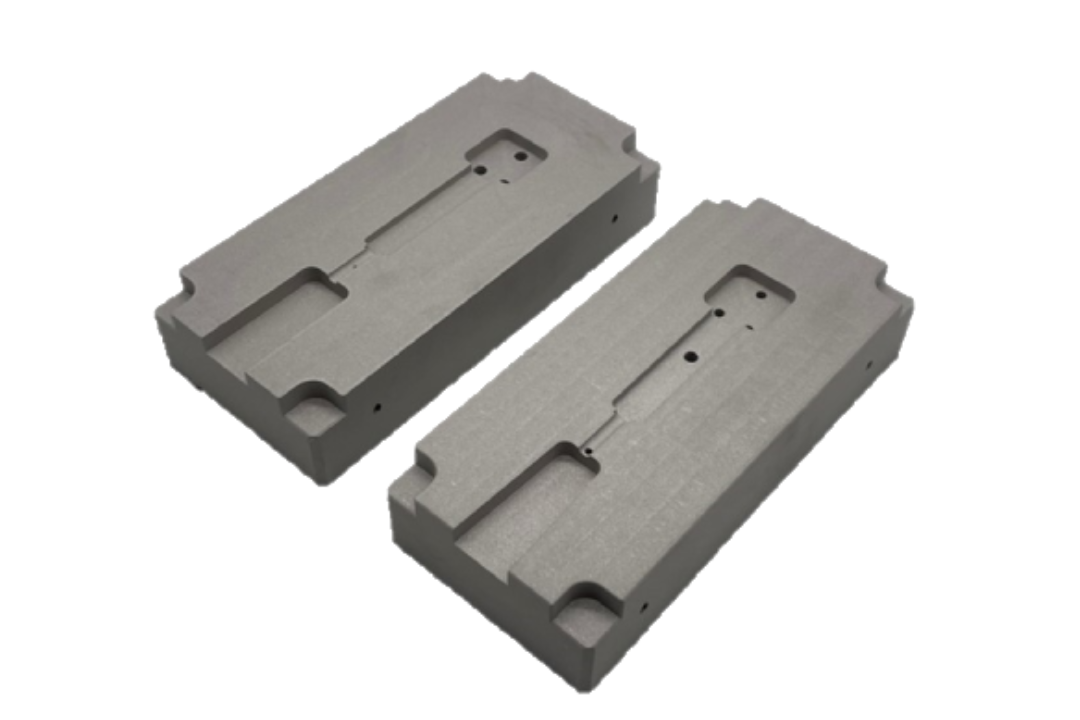
3D-printed H13 mold inserts. Photo Credit: Mantle Inc.
Westec Plastics Corp., a full-service plastic injection molder with in-house moldmaking capabilities based in Livermore, California, turned to Mantle Inc. and its 3D printing technology to solve tooling challenges with printed injection mold inserts, increase tooling capacity without requiring additional staff, cut lead times in half and help the company respond quickly to evolving customer requirements.
Tooling, a critical part of Westec’s business, requires a specific set of mold inserts, which are fabricated by experienced, highly skilled toolmakers. As customer demand grows, however, a limited staff often results in having to outsource molds with long lead times — up to 12 weeks, Westec cites. Another challenge is satisfying customers’ high-volume needs. Manufacturing molds with demanding, high-hardness tool steels, requires several process steps (milling, grinding, EDM, polishing, etc.), taking significant time to complete. Generally, Westec says it is difficult for its toolroom to find the capacity to take on new mold builds with a majority of the shop’s time being spent on tool repair and maintenance.


Westec turned to Mantle’s TrueShape technology as a potential solution. Specifically designed for production injection mold tooling, the 3D printing method enabled Westec to print production-ready mold cavity and core inserts using industry-standard materials like H13 tool steel — tough enough to withstand high-temperature, high-pressure molding of abrasive plastics —with little to no postprocessing required once printed, freeing up its toolmakers’ time to focus on specialized steps like mold finishing, repair and maintenance. This, in turn, helped cut Westec’s lead times in half. The ability to quickly manufacture production-ready steel inserts also enabled Westec to engage with customers far earlier in the design process, as well as easily keep pace with changing design requirements and new project requests.
“Tooling is the base of our company. Without quality tooling, we can’t produce quality parts, but it’s getting harder and harder to find quality tool makers.” Tammy Barras, president, Westec Plastics Corp., says. “Using Mantle’s technology, we can complete up to 70% of the job, and have our toolmakers handle the specialized steps that only a human can do. We need to take advantage of this new technology. With Mantle, we can provide our customers a service they can’t get anywhere else.”
Developing printed tooling for a medical diagnostic part demonstrates these advantages. Previously, Westec had been working to develop an eight-cavity tool to produce medical diagnostic parts for a medical device manufacturer. Design changes to the part, however, forced work on the tooling to halt until the new design could be validated.
In an effort to complete that validation process as quickly as possible, Westec used TrueShape technology to quickly produce a single-cavity tool that would match all the characteristics, including gating locations, parting lines, molding parameters, steel numbers and more, of the production tool. Once the design was confirmed using that prototype tool, the precise details and dimensions would be transferred to the production tool and manufacturing could begin.
For the Mantle printed inserts, only 10 hours of additional finish work, including grinding and EDM work, were required, as compared to 35 to 40 hours for a traditionally manufactured insert.
Once complete, the company molded parts using the printed insert and found no difference between traditionally manufactured inserts and the printed inserts.


Related Content

Moldmakers Help Drive Innovation in Medical Device Manufacturing
By embracing automation, digitalization and sustainable practices mold builders are helping to meet the medical industry’s increasing demands for precision, efficiency and compliance.
Read More
How to Use Ultra-Precision Micro Tools, Molding and Automation to Unlock High-Volume Medical Device Miniaturization
Five key areas where a molder/mold builder applies tight-tolerance tooling and advanced molding solutions to enable high-volume production of micro-molded medical parts.
Read More
Streamlining Medical Device Development With Modular, Risk-Reducing Tooling Strategy
Fast-Track Tooling enables early validation of medical device designs, reduces risks, accelerates time-to-market and ensures alignment with production molds.
Read More
How to Improve Your Current Efficiency Rate
An alternative approach to taking on more EDM-intensive work when technology and personnel investment is not an option.
Read MoreRead Next

When Is 3D Printing Cost Effective?
Hype continues to surround additive manufacturing. These three factors can help determine whether a part is worth 3D printing.
Read More
Society of Plastics Engineers Acquires 3Dnatives, Expands Additive Manufacturing Expertise
3Dnative, a leading global media and event platform, will broaden SPE’s global reach through daily industry news and distinct market-specific platforms produced in five native languages.
Read More
How to Use Strategic Planning Tools, Data to Manage the Human Side of Business
Q&A with Marion Wells, MMT EAB member and founder of Human Asset Management.
Read More