
Understanding Self-Lubricating Components
Recognizing that they are essentially conventional components with lubricant added in the form of graphite will help the molder realize their significant benefits.


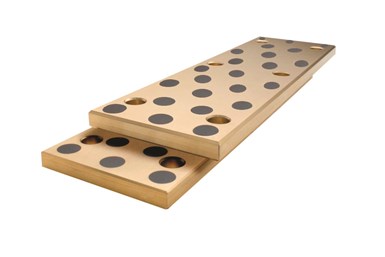
Although self-lubrication adds about 20 % to the cost of a conventional component, such self-lubricating components offer maintainability, reliability, simpler designs and a clean operation. Photo Credit: SelfLube Co.
Using self-lubricating mold components has significant benefits, but only if the molder truly understands what these components are: essentially a conventional component with lubricant added in the form of graphite plugs. Graphite is a solid lubricant, so, for those molders who are used to working with liquid lubricants such as grease or oil, a solid lubricant may seem a little strange, and so might the graphite itself.
Graphite has a near-zero coefficient of thermal expansion, which means that it doesn’t expand and contract with temperature changes like ordinary substances do. It’s not a metal, but it conducts electricity like one. It also doesn’t melt. Instead, it remains a solid at temperatures ranging to 10,000°F and then becomes a gas. It’s not very strong, but it can be formed into composites with incredible strength.


The strangest thing about graphite, however, is its molecular structure. It’s a two-dimensional crystal, and since we live in a three-dimensional world, a two-dimensional object seems to defy all logic. Graphite is one of two crystalline forms of ordinary carbon. The other is diamond, which is a conventional three-dimensional crystal, meaning it is strong in all three dimensions. Because graphite is a two-dimensional crystal, it is strong in just two dimensions.
What appears to be a solid chunk of graphite is actually a stack of very thin (one-atom-thick) crystal sheets. These thin sheets tend to slip and slide around on each other and can be easily peeled off, which turns out to be a very useful property for its use in moldmaking.
We all know that graphite makes for an excellent writing instrument. The word “graphite” comes from the Greek word grapho, which means “to write.” However, it is the same “slippery” property that’s evident when it’s used in writing that makes graphite highly useful as a lubricant as well. When you rub a pencil lead, it feels oily, although in reality, it is not oily. It is completely dry. What you are feeling is the slipping and sliding of its one-atom-thick crystal sheets. It is precisely this action that makes graphite such an excellent solid lubricant.
Features and Functions
The main function of a self-lubricating mold component is to guide and control movement. Such a mold is typically made of aluminum bronze, an excellent bearing material, with embedded graphite plugs. The mating part of the mold (the one being guided) is usually made of hardened steel. As the two parts move relative to each other, the very slippery one-atom-thick sheets of graphite peel off and become distributed over the wear surface. With each cycle, a bit more graphite is distributed, so the process continuously replenishes. Graphite doesn’t evaporate and is relatively inert, so the lubrication it imparts is essentially permanent.
Although self-lubrication adds about 20 percent to the cost of a conventional component (one that must periodically be greased), there are several benefits for this extra cost:
• Maintainability. The need for periodic greasing is eliminated, which means, over the life of the tool, the savings in preventive maintenance (PM) is likely to be several times the upfront cost for self-lubrication.
• Reliability. Lubrication is always present, eliminating the risk of failure or shortened life due to skipped PM. Also, the absence of liquid lubricants means there is nothing to attract grit and other contaminants to wear surfaces.
• Simpler designs. With self-lubricated components, there is no need to make provisions for periodic lubrication, which removes a design constraint, potentially reducing costs and/or improving functionality.
• Clean operation. No liquid lubricants to drip or spatter on parts means a very clean operation with less scrap and rework.


Related Content

The Lowdown on Guided Ejection Systems
Learn more about guided ejection systems in terms of when, where, how and why to use them to benefit you as the moldmaker. Use this guide to better understand best practices associated with guided ejection systems.
Read More
Forces and Calculations Are Key to Sizing Core Pull Hydraulic Cylinders
To select the correct cylinder, consider both set and pull stroke positions and then calculate forces.
Read More
Strategic Mold Venting – Placement and Method
Knowing where and how to vent a mold is critical for difficult areas and complex geometries.
Read More
How to Supply Cooling to Additive Tooling
Additive tooling provides limitless options for cooling a mold’s difficult-to-cool areas.
Read MoreRead Next

How to Use Continuing Education to Remain Competitive in Moldmaking
Continued training helps moldmakers make tooling decisions and properly use the latest cutting tool to efficiently machine high-quality molds.
Read More
Your Guide to Smarter, Faster Mold Design
Dive into expert-curated content delivering proven solutions for mold optimization, manufacturability and precision performance.
Read More
Overcoming Pain Points in Moldmaking with AI
Shops that embrace AI as a tool, not a threat, can enhance efficiency, preserve expertise, and attract tech-savvy talent.
Read More