
Mold in a Day Technology Slashes Tool Production, Eliminates Supply Chain Headache
Next Chapter Manufacturing says its Mold in a Day additive manufacturing technology slashes the production of tooling down to hours while maintaining the same quality and tolerance standards of conventional molds.


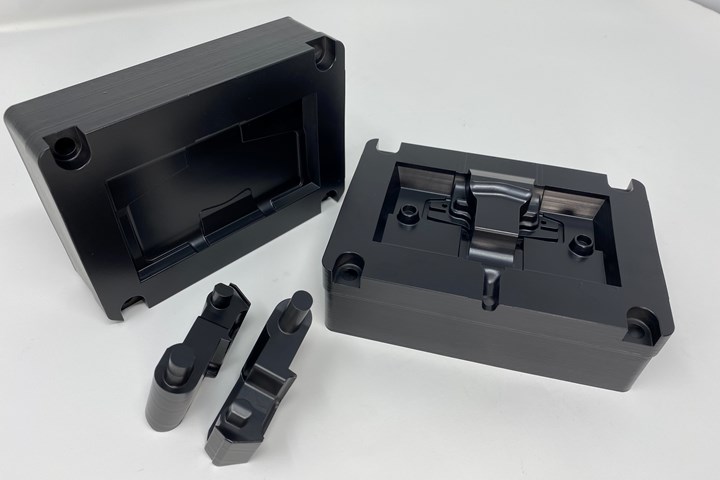
Mold in a Day (MIAD) product shot. Photo Credit: Next Chapter Manufacturing
Next Chapter Manufacturing highlights its transformative “Mold in a Day” (MIAD) technology to accelerate the injection molding process, meeting the challenge of supply chain disruptions.
Currently, the company says, it can take weeks or even months for production tooling to be completed so that it can be used to produce parts. However, with MIAD which employs the additive manufacturing (AM) process, Next Chapter is said to be able to slash that timeline from weeks or months to hours, while maintaining the same high quality and tolerance standards of conventional molds.
According to owner Jason Murphy, MIAD is made with an exceptionally durable, reinforced photopolymer. Like some other molds, MIAD is 3D-printed. Unlike other molds, MIAD is treated with a proprietary coating that reportedly offers up to 10 times the durability and longevity of other 3D-printed molds. As a result, difficult-to-use resins like filled resins, PBT, POM, PEEK, Ultem and engineered resins can be used to produce an average of 2,000 parts off one set of inserts. In addition to using it for short-run production cycles, Murphy adds that these attributes can help U.S. molders compete effectively with offshore manufacturers.
MIAD technology can be applied to molds both simple and complex. It fits both standard mold bases and common MUD unit frames. Molders can use multiple iterations simultaneously, without the need for excessive engineering tweaks.
Related Content
-
It Starts With the Part: A Plastic Part Checklist Ensures Good Mold Design
All successful mold build projects start with examining the part to be molded to ensure it is moldable and will meet the customers' production objectives.
-
Revisiting Some Hot Runner Fundamentals
What exactly does a hot runner do? If you’ve been in the injection molding industry for any length of time, you might think the answer is obvious, but it is not.
-
6 Ways to Optimize High-Feed Milling
High-feed milling can significantly outweigh potential reliability challenges. Consider these six strategies in order to make high-feed milling successful for your business.


