
Calculating the Benefits of Standard Slides
Design flexibility, time savings, engineering support and design assistance are great benefits to moldmakers from standard components.


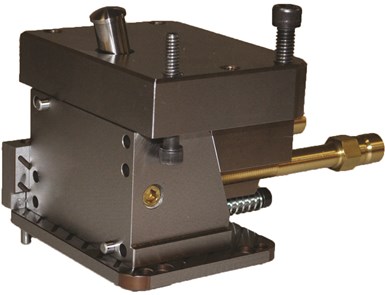
Design flexibility, time savings, engineering support and design assistance are great benefits to moldmakers from standard components. Photo Credit: Better Molding Solutions
When using standard, off-the-shelf slides, there is no question that the leadtime on a project can be reduced. The time that would have been spent squaring up blocks, machining, heat treating and grinding all of the slide components can be used to focus on the molding area—cores, cavities, slide faces, etc.
Programming time for the slide components is eliminated, and once the mold designer is tuned in to the idea of using standard slides, design time should also be reduced.


Far more debatable is the cost savings associated with using standard slides. Depending on how long you determine it takes to manufacture all of the components of a slide assembly and what you use for a shop rate, the price of standard slides could be considered a bargain or overpriced.
What you need to end this debate is an accurate assessment of the time it takes to design and build a slide assembly. Keep in mind that estimating you can complete a slide in one day—when in reality that only gets the blocks squared up and milled—is not an accurate assessment.
You must consider the cost for heat treating and all the grind time. Also, occasionally a part will be scrapped, which adds time and cost for remanufacture. Once you have accurate times, you simply multiply time by your shop rate (using valid numbers) and add material costs. This will help you decide if purchasing standard slide assemblies makes sense.
If you then believe it is a toss-up—to use standard slides only if lea times dictate—then here is a recommendation for your shop.
There are some standard slide assemblies on the market today with very conventional designs—similar to how you would design slides yourself. You can download 3D (parasolid) or 2D (dxf) files from a website then use the designs for your job. If you are not going to have sufficient time, you can purchase the slides without having to go back and change the design. However, if time is not a concern, you can make them in-house.
These assemblies offer a very comprehensive system that can fill many of your slide needs—starting out at 1.125” overall width, then from 2” wide to 9” wide in 1” increments. In each of these series there are 4 thicknesses from 0.625” to 2.125” in 1/2” increments. Each of these has three slide stroke lengths, with the longest one being at least 2.200”. With the various options, there are more than 390 combinations available, the majority of which are on-the-shelf, ready to ship.
One advantage of having so many combinations in consistent increments is that it allows more design flexibility. For example, if the 3” series is not wide enough, there is a 4” series assembly available with the same slide thickness and slide stroke; or, if the 0.625” slide thickness is not enough, there is a 1.125” thick slide with the same width and similar stroke.
This design flexibility and time savings, along with engineering support and free design assistance, offers many benefits to moldmakers.


Related Content

6 Ways to Optimize High-Feed Milling
High-feed milling can significantly outweigh potential reliability challenges. Consider these six strategies in order to make high-feed milling successful for your business.
Read More
Hands-on Workshop Teaches Mold Maintenance Process
Intensive workshop teaches the process of mold maintenance to help put an end to the firefighting culture of many toolrooms.
Read More
Moldmakers Deserve a Total Production Solution
Stability, spindle speed and software are essential consideration for your moldmaking machine tool.
Read More
Machining Center Spindles: What You Need to Know
Why and how to research spindle technology before purchasing a machining center.
Read MoreRead Next

Consider the Advantages of Using Standardized Slides
The benefits of using standard slide assemblies are realized by the moldmaker and the molder. It is a proven way to save time and money for both users.
Read More
How to Use Continuing Education to Remain Competitive in Moldmaking
Continued training helps moldmakers make tooling decisions and properly use the latest cutting tool to efficiently machine high-quality molds.
Read More
Overcoming Pain Points in Moldmaking with AI
Shops that embrace AI as a tool, not a threat, can enhance efficiency, preserve expertise, and attract tech-savvy talent.
Read More